
Understanding Miniature Scale

A practical guide to 28mm, 32mm, 40mm, and 75mm miniatures for tabletop games, painting projects, and display pieces.

Miniature scale can be a little confusing at first. When a miniature is listed as 28mm, 32mm, 40mm, or 75mm, that number does not mean every figure is exactly that many millimetres tall from base to head.

Instead, the scale is a general size category. Depending on the sculpt, a “28mm” miniature might be shorter or taller than 28mm. A crouching rogue, a hunched goblin, a tall elf, a helmeted knight, and an ogre will all measure differently even if they belong to the same scale range. Some manufacturers measure to the eyes, some to the top of the head, and some use the number more as a style guide than a strict measurement.

The easiest way to think about scale is: the number tells you what size range the miniature is intended to match, not the exact height of every individual model.
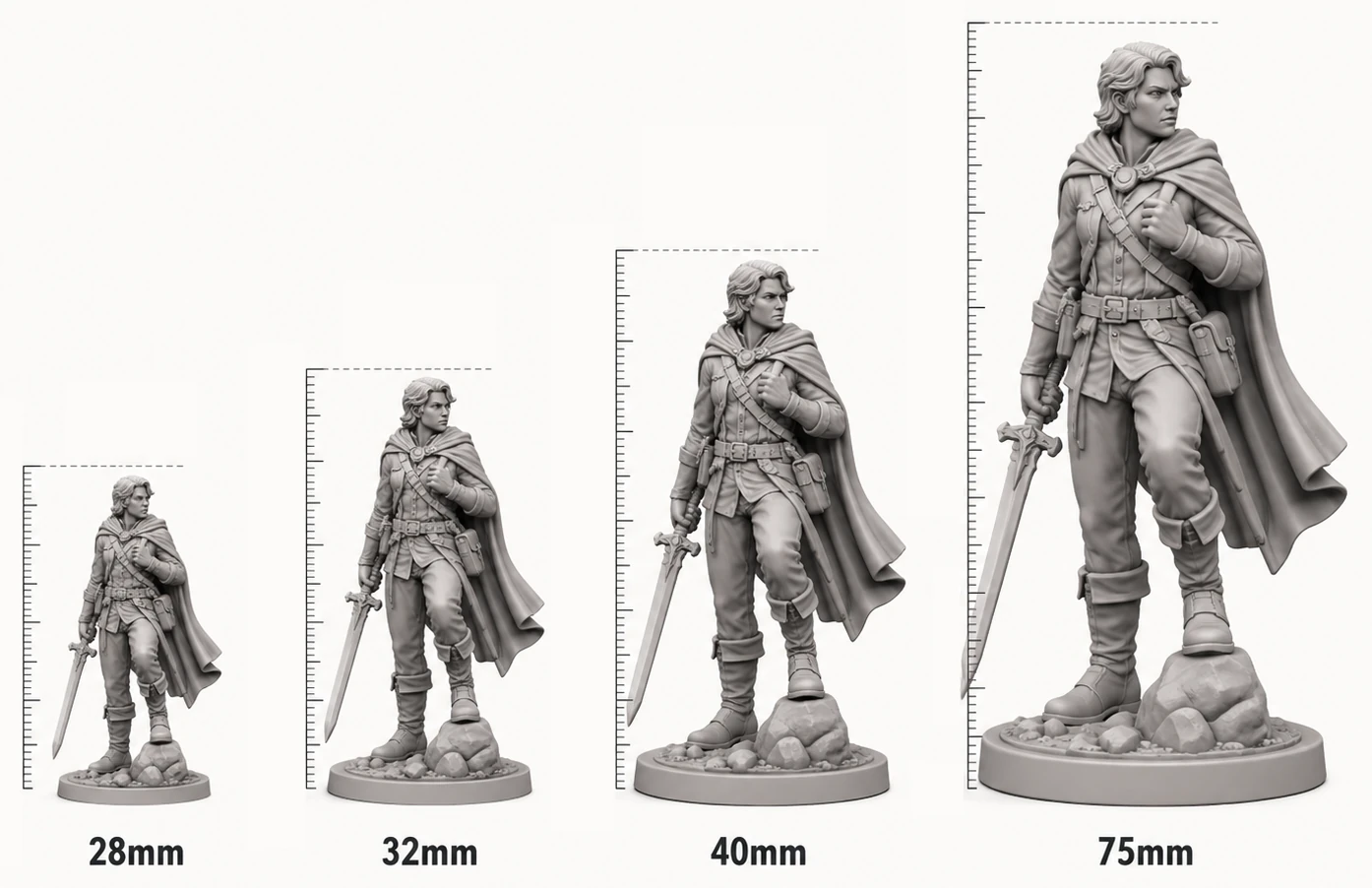
Fantasy miniatures shown together as a scale comparison

28mm Scale

28mm is one of the classic tabletop miniature scales. It is commonly used for fantasy roleplaying games, old-school RPGs, historical wargames, and many traditional tabletop ranges.

This scale works well for games played on standard battle maps with 1-inch squares, such as Dungeons & Dragons-style and Pathfinder-style games. It keeps figures compact, easy to store, and practical for larger encounters with many creatures on the table.

28mm miniatures are a good choice if you want a more traditional tabletop look or need figures that fit comfortably into crowded dungeon rooms, tight corridors, and grid-based combat.

32mm Scale

32mm is very common for modern fantasy miniatures, especially resin printed TTRPG figures. It is slightly larger than classic 28mm, which gives the sculpt more room for readable faces, armour, weapons, clothing folds, and small details.

Many modern Dungeons & Dragons-style, Pathfinder-style, and fantasy skirmish miniatures are designed around this size range. For most tabletop RPG groups, 32mm feels like a nice balance: still very usable on a battle map, but with more visual presence than 28mm.

This is often the best “default” scale for high-detail player characters, NPCs, monsters, and display-worthy tabletop pieces.

40mm Scale

40mm miniatures are noticeably larger and more dramatic. They are less about matching a traditional grid exactly and more about making the figure stand out.

This scale is great for important characters, bosses, champions, villains, large NPCs, painter-friendly versions of characters, and premium display pieces that still feel connected to tabletop gaming.

A 40mm figure may be too large for some tight grid-based encounters, but it works beautifully as a centrepiece model or a special version of a favourite character.

75mm Scale

75mm is usually considered a display or collector scale rather than a standard gameplay scale.

At this size, the figure has much more room for detail, expression, texture, and dramatic posing. Painters often prefer 75mm pieces because the larger surface area makes blending, shading, highlighting, and detail work easier to see and enjoy.

75mm miniatures are excellent for display shelves, painting projects, gifts, collector pieces, and showcase versions of important characters. They are usually too large for normal grid-based tabletop play, but they make a strong impression as a display model.

Which Scale Should You Choose?

For regular tabletop play, 28mm and 32mm are the most practical choices.

For a more detailed hero, villain, or centrepiece miniature, 40mm gives the model extra presence.

For collecting, or display, 75mm is the best choice.